MEMBER OF

6-Day Mount Kilimanjaro Climb Via Marangu Route.
Mount Kilimanjaro National Park, Gilman's Point, Tanzania
0/5
0% of guests recommend
Duration
6 Days
Tour Type
Mountain & Adventure
Group Size
50 persons
Location
Kilimanjaro
Overview
TOUR OVERVIEW
The 6-day Marangu route is one of the most popular trekking options for those looking to reach the summit of Africa’s highest peak. Commonly referred to as the Coca-Cola route, many climbers favour it because it offers a shorter trekking duration than other routes and features comfortable overnight stays in permanent huts at the designated campsites.
This six-day Marangu route takes trekkers through diverse landscapes, from the lush rainforest at the base to the alpine desert near Kibo Hut and the arctic conditions at the summit. The final ascent to Uhuru Peak begins from Kibo Hut, passing through Gilman’s Point, which offers breathtaking views before reaching the mountain's highest point. The 6-day Mount Kilimanjaro climb via the Marangu route allows less time for acclimatization, which may lead to a lower summit success rate compared to longer routes.
A DETAILED ITINERARY FOR THE KILIMANJARO CLIMB - 6-DAY MARANGU ROUTE.
Arrive in Tanzania
You will be picked up at Kilimanjaro International Airport and transferred to your hotel in Moshi town. You will meet our guide there, who will brief you on your upcoming trek and conduct an equipment check to ensure you have all the necessary mountain gear to begin your Kilimanjaro expedition 6-day Marangu route. Any missing gear can be rented locally for this day.
Day 1: Marangu Gate to Mandara Hut
-Elevation: 1860m to 2700m.
-Distance: 8 km
-Hiking Time: 4-6 hours
-Habitat: Rain Forest
After breakfast, we head to the National Park gate for the necessary formalities before beginning our trek. The trail climbs through a tropical rainforest near the upper edge of the forest line (keep an eye out for blue monkeys). The trail then widens to reveal beautiful hillsides until we reach Mandara Hut.
Day 2: Mandara Hut to Horombo Hut
-Elevation: 2700m to 3700m
-Distance: 12 km
-Hiking Time: 6-8 hours
-Habitat: Health.
Our second day on the trail begins with a steep yet non-technical ascent through the forest, eventually opening into high moorland. If the weather permits, we may catch our first glimpses of Kibo and Mawenzi peaks, two of the three volcanic summits that comprise the highest point, Kilimanjaro.
Day 3: Horombo Hut
-Elevation: 2700m to 3700m
-Distance: 10 km
-Hiking Time: 3-5 hours
-Habitat: Health.
This extra day allows for acclimatization and can be spent hiking on Mawenzi Ridge. The unique landscape offers inspiring views of Kibo Mawenzi.
Day 4: Horombo Hut to Kibo Hut
- Elevation: 3700m to 4700m
-Distance: 10 km
-Hiking Time: 6-8 hours
-Habitat: Alpine Desert.
Today, we climb gradually and then cross the lunar desert of the Saddle between Mawenzi and Kibo to reach our campsite located at the base of the Kibo crater wall. Once we arrive at camp, we rest, enjoy dinner, and prepare for the next day.
Day 5: Kibo Hut to Uhuru Peak to Horombo Hut
-Elevation: 4700m to 5895m to 3700m
-Distance: 22 km
-Hiking Time: 10-13 hours
-Habitat: Arctic
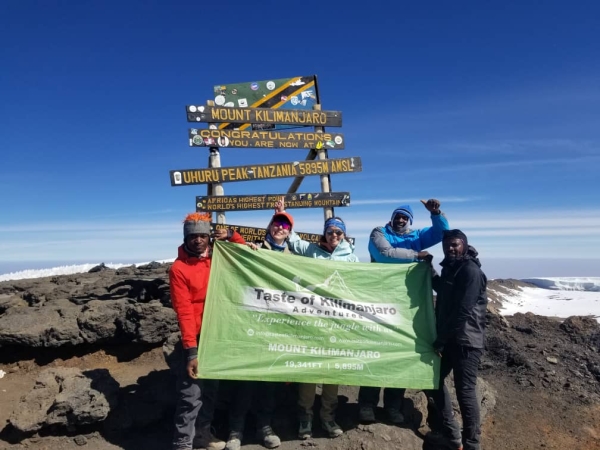
Leaving very early in the morning (around midnight), we continue our journey to the summit, hoping to catch the sunrise. The trail consists of a series of switchbacks up a steep scree slope, with climbers extending into the darkness, visible only by headlamps. Focusing on breathing and foot placement is essential. The views from the summit are dramatic and immense. After spending a few moments appreciating the plains of Africa and your accomplishments, we descend to Horombo Hut.
Day 6: Horombo Hut to Marangu Gate
-Elevation: 3700 to 1860m
-Distance: 20 km
-Hiking Time: 5-7 hours
-Habitat: Rain Forest.
Today, we will embark on a long, mostly downhill trek. Once we reach the park headquarters at Marangu Gate, we will pick up our certificates proving our achievement. Then, we will transfer to the hotel for a celebration. This marks the end of your six-day Kilimanjaro climb via the Marangu route.
Depart Tanzania.
The day is left open to unwind after the trek before your flight home. Depending on flight times, you can explore Moshi town and pick up some souvenirs before heading to the airport.
*Safari, Zanzibar, and other add-ons are available to continue exploring Tanzania.
Included/Excluded
Two nights’ accommodation in Moshi Town (Before & after the trek – B&B)
Airport pick up and drop off.
Qualified guides with mountain crew
Kilimanjaro National Park fees
All camping equipment: mountain tents, sleeping mats
Transport
Rescue fees
All meals on the mountain (breakfast, lunch, and dinner)
Guides and porters’ accommodations and their entry fees on the mountain
Pulse oximeter
First aid kit
Emergence oxygen
Katady filtered water through the trek
wages to guides and porters as approved by Kilimanjaro National Park Authority.
Flights – Domestic and international flights
Visa
Insurance
Tips to mountain crew
Personal Items
Personal Items
Travel Styles
Nature & Adventure
FAQs
Which Kilimanjaro route is best?
Lemosho is considered the most beautiful route on Kilimanjaro and grants panoramic vistas on various sides of the mountain. It is the most favorite route because it offers a great balance of low traffic, scenic views, and a high summit success rate. Thus, the Lemosho comes highly recommended and is one of our client’s favorites.
Can I climb Kilimanjaro?
Sure, you can! Climbing Kilimanjaro does not require any technical skills or special equipment, just some physical fitness and determination, people from all walks of life can achieve a successful summited. Individuals from 7 to 89 years old have made it to the top. But the challenge should not be taken lightly. You do need to understand what lies ahead. Rest assured, you will find the answers to all your questions here.
How to avoid altitude sickness at the mountain?
Altitude sickness, also called Acute Mountain Sickness (AMS), is an illness caused by exposure to low air pressure; especially low partial pressure of oxygen, which many climbers experience at high altitudes.
There are several practical steps that you can take to minimize the chances of having to abandon your climb of Kilimanjaro due to the effects of altitude sickness:
• Acclimatize before the climb - This is easier said than done if you live at sea level but if you can spend time at high altitude before the actual Kilimanjaro climb then this is the very best way to avoid altitude sickness.
Starting the climb in the best possible health and with an excellent level of physical fitness is imperative. If you are fatigued, unwell, or stressed you are more likely to suffer from altitude seconds.
• Slow and steady - You need to keep your respiration rate low during the climb you should be able to maintain a normal conversation. If you are panting or breathing hard, you must slow down. Overworking your heart and lungs substantially increases your chance of becoming ill.
• Ascend slowly - Your guides will tell you “polepole polepole (slowly slowly) throughout your climb. Because it takes time to acclimatize, your ascension should be slow. You will make slow and steady progress each day to allow for a successful summit, what we want you to achieve.
• Climb high sleep low-Climbing to a higher altitude during the day and then sleeping lower allows for better acclimatization. Most routes comply with this principle and additional acclimatization hikes can be incorporated into your itinerary.
• Drink as much water as you can-Getting up in the middle of the cold night may be an unpleasant thought but altitude dehydrates you and the better you hydrate the quicker your body can acclimatize.
Even though you may not feel like it, you should eat as much as you possibly can at every meal. This will give you plenty of energy and help you to feel great. I find it also helps me to keep warm and sleep well at night, maybe with an extra layer of clothing.
• Sleep well. Sleeping well in a tent is an acquired skill. Spend a few nights out in a tent with a sleeping bag before your climb so that you are prepared for the routine, and that your body is accustomed to sleeping in a sleeping bag on a hard surface.
• Diamox is the prescription name for the generic drug acetazolamide. And, though acetazolamide is prescribed for the medical treatment of glaucoma, sleep apnea, epilepsy, and hypertension, it’s also used to prevent altitude sickness. You should consult with your doctor before taking it and let us know if you are planning on taking it during your climb.
• Relax-Relax and think positively. Although not pleasant, the vast majority of people suffer only mild altitude sickness. Do not think that every headache is cerebral edema and that every cough pulmonary edema as this is very unlikely. By relaxing and enjoying the climb you are far more likely to have a trouble-free experience.
• Daily health checks- Our guides are all experienced in identifying altitude sickness and dealing with the problems it causes with climbers. They are continuously watching you and speaking with you throughout the climb. Twice daily, in the morning and evening, our guides will contact health checks.
Who will be my guide?
You will be amazed at the variety, quality & quantity of the food we serve you while you are on your Mount Kilimanjaro climb. As you are trekking for between 6-9 hours a day (before summit night) you will be burning a lot of calories – and as you are at a higher altitude – you are burning even more than at sea level.
• Ensuring that you are well-fed – and fully fueled for climbing Kilimanjaro is paramount – allowing you to have enough energy to get you to the top. On all of our Kilimanjaro climbs you will be fully supported by a team of professional chefs who will cater to every dietary requirement and who will provide you with 3 hot cooked meals a day – plus plenty of water and hot drinks. Every day you will be served different meals whilst on the mountain.
Snacks at camp – on arrival at camp there will be salty snacks & biscuits (we do recommend bringing some of your favorites from home though)
At each stop, there will be purified water, hot water for teas, coffee & hot chocolate!
• Dietary requirement - Remember to inform us if you have any special dietary requirements – Our chefs are also able to accommodate almost any dietary restrictions; vegan, vegetarian, gluten and lactose intolerant, and those with restrictions due to their religious beliefs.
Just let us know in advance of any dietary restrictions that you may have. If you have any questions or concerns about the food whilst on the climb, feel free to speak to our team and we can give you more information!
Our knowledgeable and experienced guides have collectively mounted Kilimanjaro well over a thousand times. They are regularly trained in the latest guiding techniques, first aid, English language, zoological and geological topics, customer relations, and environmental conservation. They are fully licensed by the National Park authorities and most importantly they love their job.
What types of food and drinks will be provided during Kilimanjaro?
You will be amazed at the variety, quality & quantity of the food we serve you while you are on your Mount Kilimanjaro climb. As you are trekking for between 6-9 hours a day (before summit night) you will be burning a lot of calories – and as you are at a higher altitude – you are burning even more than at sea level.
• Ensuring that you are well-fed – and fully fueled for climbing Kilimanjaro is paramount – allowing you to have enough energy to get you to the top. On all of our Kilimanjaro climbs you will be fully supported by a team of professional chefs who will cater to every dietary requirement and who will provide you with 3 hot cooked meals a day – plus plenty of water and hot drinks. Every day you will be served different meals whilst on the mountain.
Snacks at camp – on arrival at camp there will be salty snacks & biscuits (we do recommend bringing some of your favorites from home though)
At each stop, there will be purified water, hot water for teas, coffee & hot chocolate!
• Dietary requirement - Remember to inform us if you have any special dietary requirements – Our chefs are also able to accommodate almost any dietary restrictions; vegan, vegetarian, gluten and lactose intolerant, and those with restrictions due to their religious beliefs.
Just let us know in advance of any dietary restrictions that you may have. If you have any questions or concerns about the food whilst on the climb, feel free to speak to our team and we can give you more information!
• Staying hydrated - Keeping hydrated is crucial in the Kilimanjaro acclimatizing process – and you will get dehydrated easily, not just from walking each day but by breathing in the air at higher altitudes. We ensure that there is always a plentiful supply of treated and filtered water in the camp each morning/ night and water will also be provided at lunch. Depending on your physiology you will need to take in between 3-4 liters of water each day. If you are not used to drinking this amount of water, many people find that adding electrolytes or flavored cordials helps to keep the taste buds excited. There will also be hot drinking water at the camp in eat morning/ evening as well as the lunch stop with a selection of teas, coffee, and hot chocolate.
What is the best month to climb Kilimanjaro?
The best times to climb regarding the weather (avoiding rain) are from January to early March, and June to mid-October. There’s a long, dry winter and a green season with two rainy periods at each end. December, January, February, and March are the warmest months, with clear mornings and evenings, and clouds during the day that occlude the summit in the early afternoon hours.
Tour Location
Mount Kilimanjaro National Park, Gilman's Point, Tanzania
Reviews
0/5
Not Rated
Based on
0 review
Excellent
0
Very Good
0
Average
0
Poor
0
Terrible
0
No Review
Taste of Kilimanjaro Adventures

Member Since Nov 2025
from
4,188,608.00TZS
{{start_date_html}}
{{type.desc}}
{{type.display_price}} per person
Extra prices:
({{type.price_type}})
{{type.price_html}}
({{type.price_type}})
{{ type.price }}%
{{ formatMoney(type.price) }}
- {{total_price_html}}
- {{pay_now_price_html}}
You might also like
12%
From
6,515,612.00TZS
per person
Kilimanjaro
Always available
No group limit
Baraka Trails Ltd.
From
5,119,409.00TZS
per person
Kilimanjaro
Always available
1-50 people
Taste of Kilimanjaro Adventures
From
6,138,120.00TZS
per person
Kilimanjaro
Always available
1-50 people
LAPWINGS COMPANY LTD
From
4,886,709.00TZS
per person
Kilimanjaro
Always available
1-50 people
Taste of Kilimanjaro Adventures
from
4,188,608.00TZS